

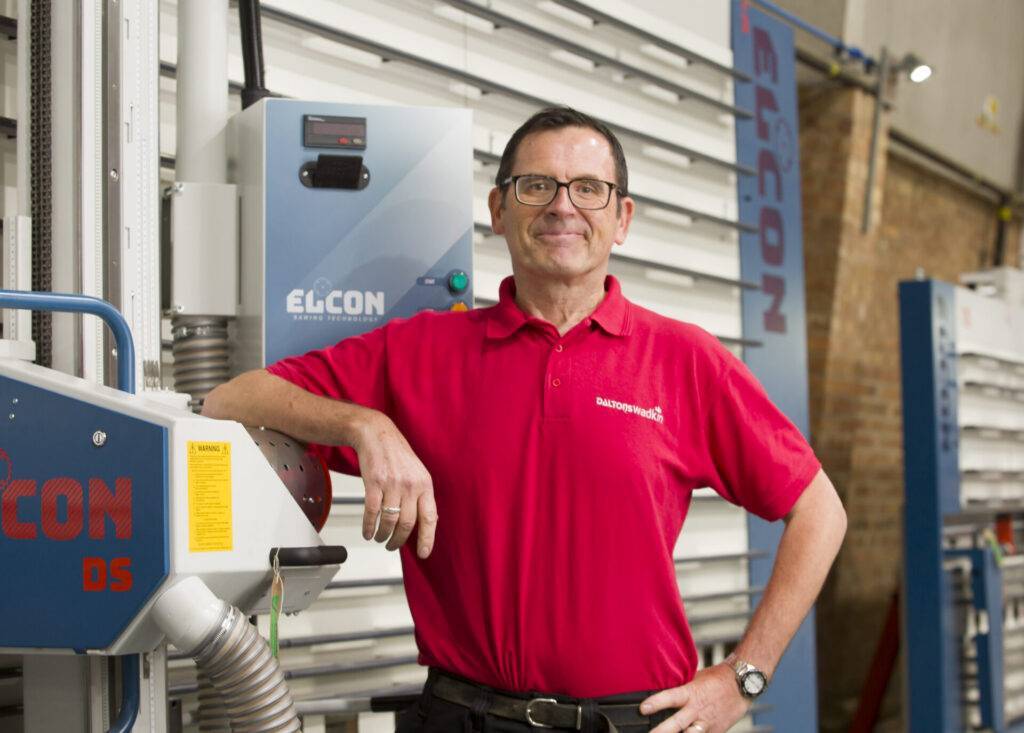
Author: Ian Conyers, Technical Trainer at Daltons Wadkin, a leading UK multi-material machine solution supplier
After more than four decades in the woodworking and manufacturing industry, Ian Conyers is preparing to retire this March.
His career has taken him from a teenage apprentice on the shop floor, through joinery shops, specialist manufacturers, the Ministry of Defence (which he can’t talk a whole lot about), the prison service, and ultimately into industrial training, where he has spent the last decade helping manufacturers operate machinery safely, efficiently, and confidently.
Along the way, that journey has taken him into some extraordinary environments — from luxury hotels and high-end automotive facilities to distilleries, airliner hangars, remote islands, and workshops most people never get to see.
As part of Ian’s final months at Daltons Wadkin, we sat down with him to reflect on his career, the changing skills landscape, and why training has become one of the most important, and misunderstood, investments manufacturers can make today.
Ian, take us back to the start. How did your career in manufacturing begin?
I left school in 1983 and went straight into a wood machining apprenticeship. That was the done thing back then. You learned on the job, surrounded by people who knew their trade inside out. There was no shortcut. You learned by doing, watching, getting things wrong, and being corrected.
That grounding stayed with me. Over the years, I worked in joinery shops, specialist manufacturing, point-of-sale production, and even spent time with the Ministry of Defence. Eventually, though, everything I’d learned started to come together when I moved into training roles.
Looking back, I don’t think I appreciated at the time just how varied that journey would become. One week I’d be working in a traditional cabinet-making workshop, the next I’d be standing inside an aircraft hangar at an airport, being told I needed an escort everywhere I went — only to walk out of the toilets and be met by two armed police officers. I very nearly went straight back inside with my hands up!
Those moments stick with you. They also teach you quickly that manufacturing happens everywhere, often behind the scenes, and always relies on people who know what they’re doing.
You didn’t originally set out to be a trainer. What changed?
The turning point was the prison service. I joined as a discipline officer but later moved into workshop instruction, delivering technical qualifications to offenders preparing for release.
It was challenging, but it completely reshaped how I thought about training. You quickly realise it’s not about paperwork or ticking boxes. It’s about communication, patience, and understanding how different people learn, especially those with low confidence or additional needs.
That experience gave me the bug for training. I saw first-hand that practical skills, taught properly, can genuinely change outcomes. Those lessons have stayed with me ever since.
In many ways, that environment forced you to become a better communicator. You learned to read people, adapt quickly, and strip things back to fundamentals. Those skills became invaluable later on when training operators under pressure in live production environments.
How different is the skills landscape now compared to when you started?
Completely different. When I started, wood machining courses were common. Today, there are very few colleges offering them at all.
That means businesses can’t rely on people arriving with baseline skills anymore. At the same time, machinery is more advanced, more automated, and higher risk if used incorrectly. The idea that someone can just “pick it up” doesn’t hold up anymore.
Training isn’t optional now. It’s fundamental.
What I’ve also seen is that experience itself has become rarer. Many of the people who would once have passed skills down organically have retired or moved on. Without structured training, that knowledge simply disappears.
Why do you think some businesses still struggle to prioritise training?
There are lots of pressures. Production targets, margins, staff availability. Training is often seen as downtime rather than an investment.
Some employers worry that if they train people too well, they’ll leave. Others simply don’t have the internal expertise to deliver training properly. The result is that training becomes reactive — delivered after an incident — rather than strategic.
But what I’ve seen time and again is that the businesses that invest in training get more from their people and their machines.
You’ve worked with a huge range of businesses. What patterns stand out?
I’ve delivered training to hundreds of companies, from two-person joinery shops to global names like Dyson, Bentley, and Land Rover.
That variety is one of the great privileges of the role. One day you might be working in a whisky distillery alongside coopers — which I can highly recommend, for reasons I probably shouldn’t go into — and the next you’re in a high-end cabinet shop producing bespoke wardrobes for penthouse suites at Claridge’s.
Those environments couldn’t be more different, but the principles are the same. The biggest misconception I see is that experience automatically equals competence. Someone may have been around machinery for years, but without refreshers, bad habits creep in. Knowledge becomes siloed with one person, and when they’re off, everything slows down.
The best workshops aren’t always the biggest or the most automated. They’re the ones where training is ongoing, standards are reinforced, and people feel supported rather than rushed.
Why is on-site, machine-specific training so important?
Because training people on the wrong machine doesn’t work.
Every workshop is different — different makes, control systems, layouts, risks. I’ve lost count of how many times I’ve heard operators say, “Where’s the green button you were pressing?”
That’s why Daltons Wadkin delivers training on the customer’s own equipment, in their own environment. Operators learn using their controls, their processes, and their risks. It builds confidence faster and embeds safe habits that actually stick.
I’ve seen this first-hand in some extraordinary places. At Aston Martin, I once casually remarked that a car in the workshop looked like the original James Bond DB7. only to be told that it actually was. Moments later, sheets were hurriedly thrown over new prototypes as if I’d walked into MI5. The irony is, I wouldn’t know an Aston Martin from a horse (cars really aren’t my thing).
But even in those environments, the same truth applies: training has to be relevant to the machine in front of you, not a generic example somewhere else.
From a legal and safety perspective, how critical is operator training?
It’s both a legal and moral responsibility. Under Regulation 9 of PUWER, employers must ensure anyone using work equipment has received adequate training.
But beyond compliance, trained operators are safer, more consistent, and less likely to damage equipment. They understand risks, follow safe systems of work, and contribute to a stronger safety culture overall.
Good training protects people, machines, and businesses.
You’ve seen materials and processes diversify. How transferable are core skills today?
Very transferable. While my background is in woodworking, modern workshops often process plastics, composites, insulation boards, aluminium. Sometimes all under one roof.
The materials change, but the principles don’t. Safe setting, safe operation, understanding machine behaviour. Those fundamentals apply whether you’re cutting wood, steel, or Perspex.
That’s opened up opportunities I never imagined early in my career, including working in environments as varied as aircraft maintenance hangars and remote locations like Ascension Island, where very few civilians ever go, let alone hike to the top of Green Mountain with colleagues. Not something you expect from a career that starts with a planer and a piece of timber.
Tell us about the Daltons Wadkin training team. What makes it different?
When I joined Daltons Wadkin in 2019, the training function was much smaller. Today, the Red Team is five strong, delivering PIABC-assured training across the UK, Ireland, and beyond.
That growth reflects a deliberate decision by the business to treat training as a core capability, not a bolt-on. Alex Dalton has always been deeply involved, constantly asking how we can improve, evolve, and deliver more value to customers.
It’s also a team I’ve been incredibly proud to be part of. We support each other, share knowledge, and draw on decades of combined experience. If one of us doesn’t know the answer, someone else usually does.
One moment that really brought it home for me was training an apprentice I’d worked with years earlier — and then, very recently, delivering training at a college where he’s now a joinery lecturer, passing those same skills on to the next generation. That’s incredibly satisfying.
As you approach retirement, what stands out most from your career?
I feel incredibly fortunate. I’ve worked with skilled, passionate people, and I’ve had the chance to pass knowledge on rather than just accumulate it.
Machines will keep evolving. Software will get smarter. But none of it works without people who understand what they’re doing and why they’re doing it.
After 43 years, the biggest lesson I’ll take with me is this: the future of manufacturing won’t be defined by the machines we buy, but by the skills we invest in — and how seriously we take the responsibility of developing them.


